Automation in 2026: Principles, Types, and Real Business Impact
Automation in 2026: Principles, Types, and Real Business Impact
Automation has become a defining feature of modern industry, services, and even everyday life. In 2026, automation is not just a technological buzzword—it's a strategic necessity for organizations aiming to scale efficiently, enhance quality, cut costs, and remain competitive. This article explores the core principles of automation, its primary types, and the tangible impact it delivers to businesses worldwide.
Understanding Automation: Core Concepts and Definitions
Automation refers to the application of technology, mathematical methods, and control systems to perform processes with minimal or no human intervention. Its roots stretch back to ancient mechanisms for measuring time and managing water flows, but the term only gained widespread use in the 1940s with the rise of industrial controllers. Today, automation encompasses everything from simple relay-based controls to advanced software-driven and AI-powered systems.
At its heart, automation aims to:
- Relieve people from repetitive, hazardous, or complex tasks
- Increase efficiency and productivity
- Improve product quality and consistency
- Optimize resource use and reduce costs
Automation is achieved with a mix of mechanical, electronic, hydraulic, pneumatic, and digital tools—often working together in integrated systems.
Types of Automation: From Basic to Hyperautomation
Automation has evolved through several stages, each offering distinct capabilities. Here are the main types you’ll encounter in 2026:
| Type of Automation | Description | Typical Applications |
|---|---|---|
| Fixed/Hard Automation | Rigid, dedicated systems for high-volume production | Automotive manufacturing, bottling |
| Programmable Automation | Systems that can be reprogrammed for different tasks | Batch production, CNC machines |
| Flexible/Soft Automation | Easily reconfigurable systems for varied products | Electronics, custom assembly |
| Industrial Automation | Large-scale automation of manufacturing and logistics | Factories, logistics hubs |
| Office/Business Automation | Automating administrative, sales, and support workflows | CRM, ERP, chatbots |
| Hyperautomation | Integrating AI, ML, and RPA for end-to-end process automation | Finance, HR, customer service |
Hyperautomation is a leading trend, as identified by Gartner. It combines machine learning (ML), software solutions, and classic automation to automate not only routine tasks but also decision-making processes, driving unprecedented efficiency across digital and physical workflows.
Control Principles: Feedback and Logic in Automation
Modern automation is built on several fundamental control strategies:
- Open-loop (No Feedback):
- The system operates based on preset instructions, regardless of the output. Example: a timed sprinkler system.
- Closed-loop (Feedback):
- The system monitors its output and adjusts its actions to maintain a target state. Example: a thermostat-controlled heating system responding to room temperature.
- PID Controllers:
- Widely used in industry, these controllers continuously calculate the error between a desired setpoint and the actual value, adjusting the process using proportional, integral, and derivative logic.
- Sequential/Logic Control:
- Involves executing programmed sequences based on system states or external inputs. Early versions relied on relay logic; today, programmable logic controllers (PLCs) and industrial computers are common.
Tip: When automating a process, always determine whether feedback control is necessary for your application. Feedback systems are essential where precision and adaptability matter.
Automation Technologies and Tools
Automation relies on an ecosystem of hardware and software. Some of the key components include:
- Sensors: Gather real-time data (temperature, position, pressure, etc.)
- Controllers: Process inputs and manage outputs (PLCs, microcontrollers, industrial PCs)
- Actuators: Carry out physical actions (motors, valves, robots)
- Software: Orchestrates process logic, data analysis, and user interfaces (ERP, MES, SCADA)
- Robotics: From robotic arms to autonomous mobile robots for logistics
- AI & Machine Learning: Enable predictive maintenance, intelligent process optimization, and adaptive automation
Automation in Industry: Benefits, Challenges, and Use Cases
Key Benefits
- Productivity Boost: Automated systems operate 24/7 without breaks, dramatically increasing output.
- Cost Reduction: Lower labor costs, reduced waste, and optimized resource usage cut operational expenses.
- Quality Improvement: Consistent execution reduces defects and ensures high standards.
- Safety: Machines handle dangerous or repetitive tasks, minimizing workplace injuries.
- Flexibility: Modern automation systems can be quickly reconfigured to respond to market changes.
Real-World Examples
- Manufacturing: Robotic cells, CNC machines, and conveyor systems streamline production lines.
- Logistics: Automated warehouses use robotics and AI for inventory management and rapid order fulfillment.
- Customer Service: AI chatbots handle inquiries 24/7, slashing response times from hours to seconds (see our blog).
Case Study: A leading retail chain implemented an AI-driven chatbot for customer support, reducing average response times from two hours to just 30 seconds, while boosting customer satisfaction and repeat sales by 34%.
Challenges and Risks
- Upfront Investment: Automation infrastructure can require significant capital.
- Skill Gaps: Staff must be trained to manage and maintain automated systems.
- Complexity: Integrating automation with legacy processes demands careful planning.
- Handling Exceptions: Automated systems must be designed to cope with unexpected events or require human intervention for rare, complex issues.
Automation Beyond Industry: Business Process and Office Automation
Automation isn’t limited to factories. In 2026, businesses leverage automation across sales, marketing, HR, customer support, and more.
Popular Business Automation Tools
- CRM Automation: Automate lead tracking, follow-ups, and reporting.
- ERP Systems: Integrate and automate procurement, inventory, finance, and production.
- Chatbots: Provide instant responses and self-service for customers (learn more).
- RPA (Robotic Process Automation): Automate repetitive data entry, invoicing, and compliance tasks.
Table: Examples of Business Processes Automated in 2026
| Area | Example Automation | Impact |
|---|---|---|
| Sales | AI chatbot lead qualification | +28% lead conversion |
| Customer Support | 24/7 AI chatbot | -95% response time |
| HR | Automated onboarding | Faster staff integration |
| Finance | Invoice processing (RPA) | Reduced manual errors, faster payment |
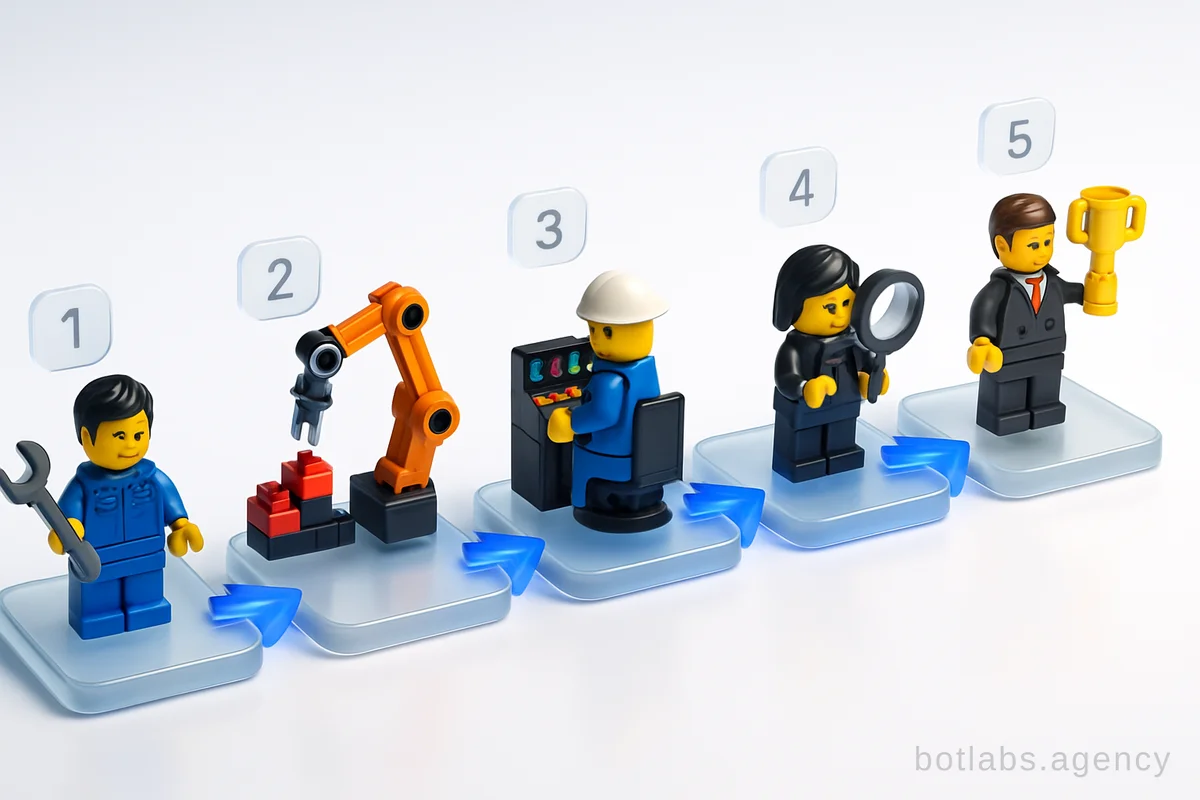
Steps to Successful Automation: A Practical Guide
- Assess Needs: Identify repetitive, high-volume, or error-prone processes.
- Define Goals: What improvement do you seek—cost savings, speed, quality?
- Select Solutions: Choose the right mix of hardware, software, and control systems.
- Pilot Projects: Start small; automate a single process and measure results.
- Scale Gradually: Expand automation based on ROI and lessons learned.
- Train Staff: Upskill your team to manage, maintain, and optimize new systems.
- Monitor & Improve: Use analytics and feedback loops to refine automation continuously.
Tip: For best results, work with a partner experienced in both technology and business process optimization. Contact BotLabs Agency for a free consultation.
The Future: Hyperautomation and AI-Driven Transformation
Hyperautomation is the next frontier, combining AI, machine learning, and advanced analytics with traditional automation. This allows businesses to automate not just routine tasks but also complex decision-making, prediction, and adaptive workflows. In 2026, hyperautomation is delivering:
- End-to-end digital workflows across departments
- Predictive maintenance and resource optimization
- Personalized customer experiences at scale
Callout:
Hyperautomation expands the potential of automation, letting businesses do more with less and react instantly to market changes.
Table: Automation System Components and Roles
| Component | Role in Automation |
|---|---|
| Sensors | Collect real-time process data |
| Controllers | Analyze data, make decisions, initiate actions |
| Actuators | Execute physical actions (move, open/close, etc) |
| Software | Orchestrate logic, reporting, user interface |
| Robotics | Physical task execution, material handling |
| AI/ML | Predict, optimize, adapt to new situations |
What is the difference between automation and hyperautomation?
Automation refers to using technology to perform tasks without human involvement. Hyperautomation builds on this with AI and advanced analytics, automating even complex decision-making processes.
How can small businesses benefit from automation?
Even small businesses can automate sales, customer support, and administrative tasks using tools like chatbots, CRM integrations, and RPA, improving efficiency and competitiveness.
What are the key risks of automation?
Main risks include high initial costs, integration complexity, skill gaps, and the need to manage exceptions or non-standard events. Careful planning and ongoing management help mitigate these risks.
For more practical guides and real-world automation success stories, visit our blog.

Need a chatbot for your business?
We automate your processes and boost sales.