
Multi-agent AI systems for business: how they work and when to use them
- What is a multi-agent system?
- Workflow, single agent, or agent team?
- How an orchestrator and workers operate
- What Anthropic’s results show—and what they do not
- How to calculate the full cost
- When multiple agents may fit
- Production risks and controls
- MCP and A2A: tools and agent-to-agent communication
- A practical evaluation plan
- Conclusion
- Frequently asked questions
- Sources
Several AI agents can research different sources in parallel, check parts of a complex request, and combine their findings. More agents also mean more model calls, coordination, logs, and failure points. The question is not whether a system can launch a team of agents, but whether parallel work creates measurable value for a specific process.
This article explains the main architectures, costs, limits, and a practical way to decide whether a business needs a multi-agent system, a single agent, or a conventional automated workflow.
What is a multi-agent system?
A multi-agent system is software in which several language-model-based agents perform related roles: planning work, calling tools, handing off tasks, and combining results. Here, an agent means a model operating in a loop of assessing state, choosing an action, and receiving a tool result—not simply a separate chat or interface persona.
Several roles in a prompt do not necessarily make several independent agents. If one model follows fixed steps in sequence, the design is closer to a workflow. For terminology and automation boundaries, see chatbot or AI agent.
Workflow, single agent, or agent team?
| Approach | How it works | When it fits |
|---|---|---|
| Rules and workflow | Steps and transitions are defined in advance | A repeatable process with predictable inputs |
| Single agent with tools | Chooses its next step within defined permissions | The request varies, but does not need independent parallel research |
| Orchestrator and workers | A coordinator splits subtasks, workers run in parallel, and the coordinator synthesizes | Broad research across independent directions |
| Peer network | Agents hand off work without one permanent coordinator | Narrow cases where this interaction is justified and observable |
For many companies, moving from manual work to a clear workflow creates more value than a complex agent team. An example of automating intake is covered in handling inbound leads.
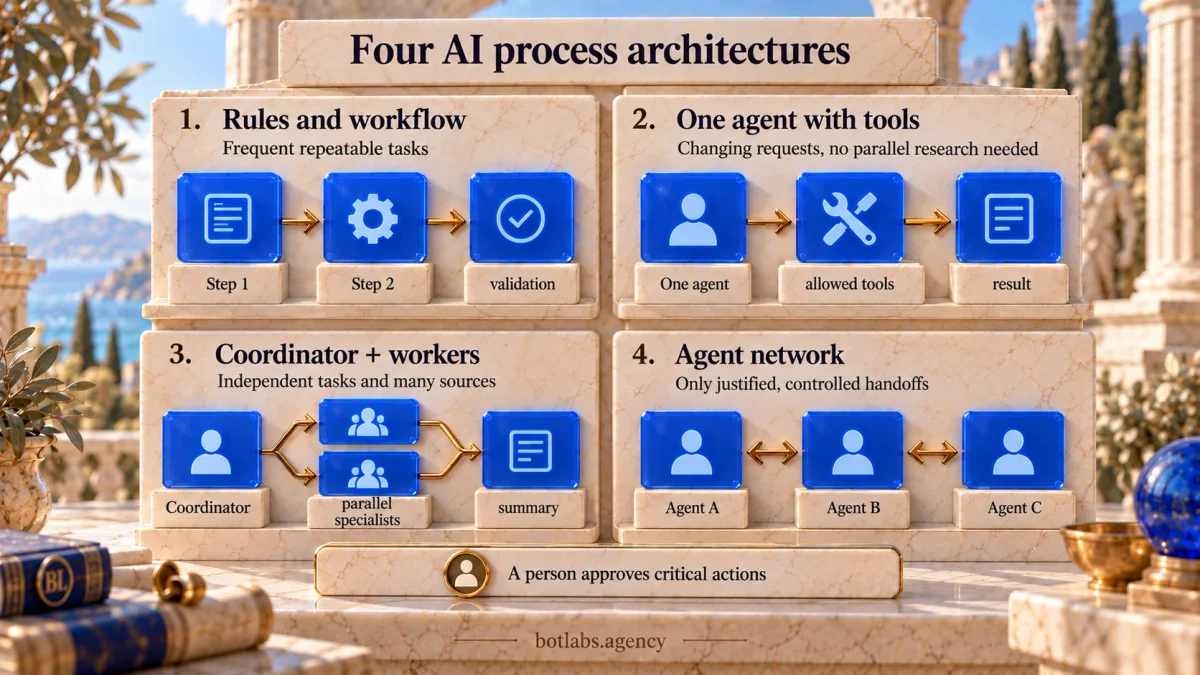
How an orchestrator and workers operate
A typical cycle has five steps: the coordinator clarifies the goal and constraints; creates small subtasks with different sources or criteria; runs workers in parallel; checks and compares their results; then returns a synthesis with references or hands an action to a person.
Parallelism helps only when subtasks are genuinely independent. If agent B cannot start until agent A finishes, execution is sequential and coordination adds latency. Define the output format, completion criteria, iteration limit, and fallback when a worker fails to respond.
What Anthropic’s results show—and what they do not
Anthropic described its own Research system, where an orchestrator delegated complex research to parallel subagents. In that system’s internal evaluation, a configuration with Claude Opus 4 as the lead and Claude Sonnet 4 as workers outperformed a single Claude Opus 4 by 90.2%. Anthropic also reported that its agents typically used about four times as many tokens as chat interactions, while its multi-agent systems used about 15 times as many.
These are results from a specific implementation and Anthropic’s internal evaluations, not an independent universal benchmark or a promise of gains for business workflows. They illustrate a trade-off: more computation can help with broad, complex research, but does not guarantee a better result by itself. Before adopting the approach, evaluate your own task set and the cost of a complete successful process, not just one request.
How to calculate the full cost
Tokens are only one cost. Include tool and external API calls, response time, retries, log storage, monitoring, integration maintenance, and human review. For a useful comparison, calculate the cost per acceptable result: divide total scenario costs by the number of outputs that pass quality checks.
Compare at least three options on the same examples: the manual process, the simplest automated approach, and a multi-agent system. Measure accuracy against defined criteria, manual correction rate, time, error frequency, and cost. For a cost model, see how much an AI agent costs for a business.
When multiple agents may fit
Consider a multi-agent design when a task has independent research paths, information exceeds one working context, different tools or specialties are needed, and a better result is worth the additional expense. Candidate experiments include reviewing many suppliers, broad market research, or comparing technical and financial documents.
These are candidates for testing, not automatic reasons to deploy. If a task is easy to express as rules and repeats frequently, conventional automation or a workflow is usually simpler to evaluate and maintain. Criteria for choosing an AI solution for lead intake appear in automating inbound leads.
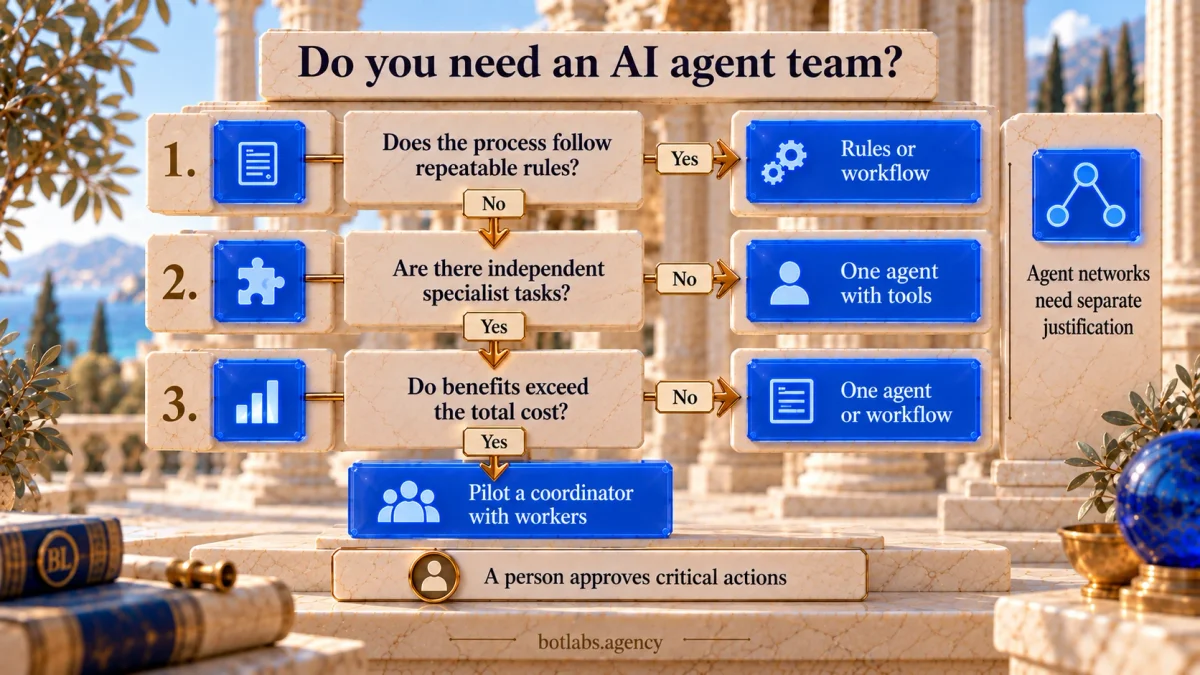
Production risks and controls
Coordination creates new failure modes: workers duplicate effort, lose an important constraint, pass along an unchecked claim, or extend the run through repeated retries. It also makes diagnosis harder, costs less predictable, and access to tools and data broader.
Set limits on budget, agent count, and steps; grant each agent only the permissions it needs; keep sources and intermediate results; and check consequential decisions with deterministic rules or a person. A model should not independently approve payments, change important records, or send external messages without appropriate controls. For broader security, define access boundaries for tools and data, log actions, and assign an owner for review.
In June 2025, Gartner forecast that more than 40% of agentic AI projects would be canceled by the end of 2027 because of rising costs, unclear business value, or inadequate risk controls. This is an analyst forecast about agentic AI projects broadly, not a measured outcome or a statistic specifically about multi-agent systems.
MCP and A2A: tools and agent-to-agent communication
MCP (Model Context Protocol) standardizes how AI clients connect to external tools and context sources. A2A (Agent2Agent) describes interaction between separate agents, including task and result handoffs. They address related but different needs; using a protocol alone does not guarantee system-wide compatibility or freedom from vendor dependence.
The Linux Foundation announced the Agentic AI Foundation in December 2025, with MCP, Goose, and AGENTS.md among its initial projects. Google introduced A2A in April 2025, and A2A joined AAIF in August 2026. When assessing a product, check actual versions, client and server compatibility, access policies, and support quality rather than relying only on a standards claim in marketing material.
A practical evaluation plan
- Choose one process with a clear outcome and record baseline cost, time, and error rate.
- Build a set of typical and difficult examples, including incomplete inputs and exceptions.
- Start with the simplest implementation that can perform the task and define acceptance criteria.
- Compare it with a multi-agent version on the same set; measure quality, total cost, latency, and human review needs.
- Run a limited pilot with logs, limits, rollback, and an accountable process owner. Expand only if the benefit holds under real conditions.
Conclusion
A multi-agent system is justified by a proven improvement on a task that can be divided into independent parts, not by the number of agents. Measure the process, test a simpler option, and then compare it with a multi-agent architecture on quality, cost, and reliability. Access controls, budget limits, and human review belong in the design from the first pilot.
Frequently asked questions
It is a system of several AI agents that perform related roles, exchange tasks or results, and work toward a defined goal.
A workflow follows predefined steps. A multi-agent system can distribute work among agents, often in parallel, adding flexibility as well as complexity.
No. Results depend on the task, models, tools, and coordination. Compare approaches on examples you have independently checked.
Anthropic reported that its internal multi-agent system used about 15 times as many tokens as chat. That figure is not universal; measure the full cost for your own use case.
MCP helps standardize connections to tools and data, while A2A addresses communication between agents. Check supported versions and actual interoperability.
Choose one measurable process, record baseline quality and costs, test a simple solution, and only then compare it with a multi-agent pilot.
Sources
- Anthropic: How we built our multi-agent research system (June 13, 2025) — internal 90.2% evaluation and token-use figures.
- Gartner: agentic AI project cancellation forecast (June 25, 2025) — forecast of more than 40% by end of 2027.
- Linux Foundation: AAIF formation (December 9, 2025) — initial MCP, Goose, and AGENTS.md projects.
- Google Developers Blog: A2A announcement (April 9, 2025) and A2A: joining AAIF (August 27, 2026).
Which AI architecture fits your business?
In 15 minutes with a BotLabs specialist, compare a single agent, a fixed-step pipeline, and an orchestrated team for your workflow. Outline a first implementation stage and questions about cost and error controls.
One workflow.
A first step with AI.
Compare implementation approaches.
Discuss costs and risks.