Chatbot or Mobile App: Which Is Right for Your Business in 2026?
Introduction: The Digital Dilemma for Modern Businesses
In 2026, business owners face a crucial decision: should you invest in a chatbot or develop a mobile app to engage customers and streamline operations? With digital transformation accelerating and customer expectations evolving, this choice can define your competitive edge. This article dives into the practical differences, advantages, and limitations of chatbots and mobile apps, drawing on real-world cases—including BotLabs Agency’s experience—and providing a framework to help you choose the right path.
Chatbots vs Mobile Apps: Defining the Landscape
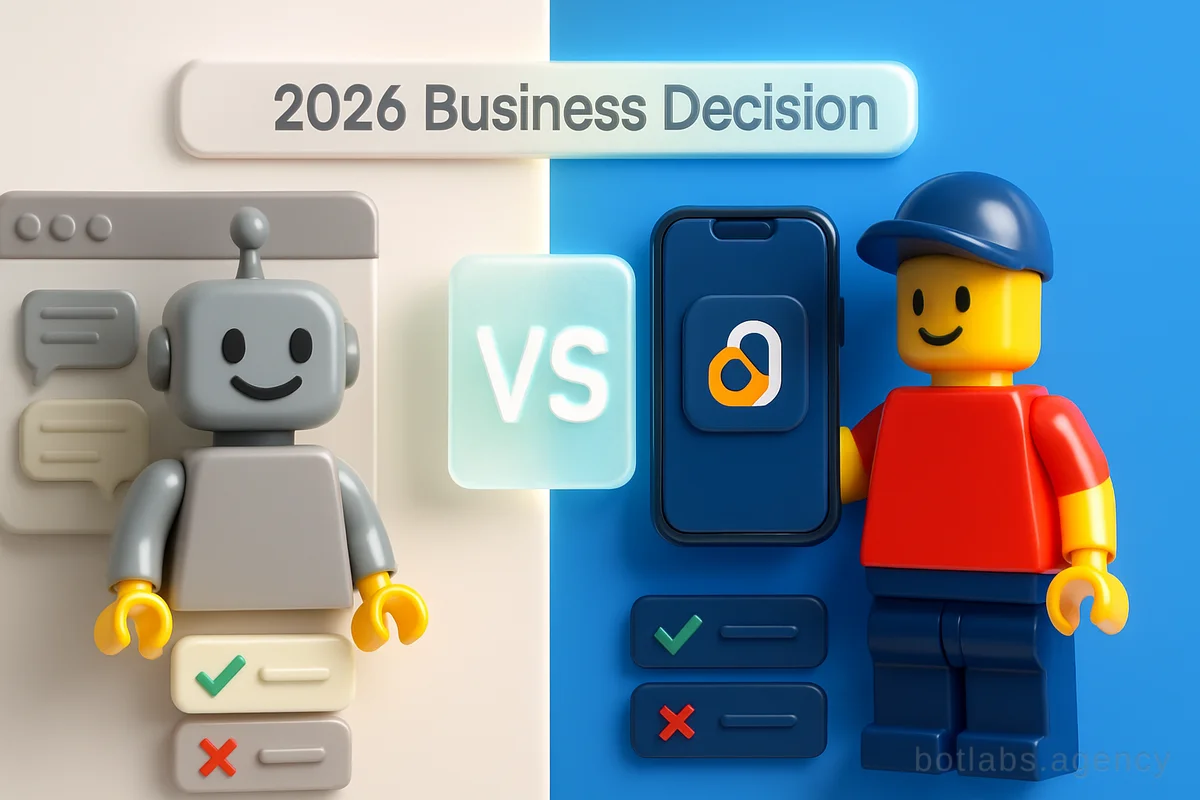
Both chatbots and mobile apps offer unique ways to automate, scale, and personalize customer interactions. Mobile apps typically deliver rich, branded experiences and deep integrations, but require users to download, install, and learn a new interface. Chatbots, conversely, exist within messaging platforms your audience already uses, offering instant, conversational access, often with lower barriers to entry and faster development cycles.
| Feature | Chatbot | Mobile App |
|---|---|---|
| Accessibility | No download, instant use | Requires download/installation |
| Development cost | Lower (usually) | Higher (esp. cross-platform) |
| Time to launch | Weeks | Months |
| User learning curve | Minimal, familiar UI | Often steeper |
| Updates & support | Centralized, easy push | Requires user update |
| Multichannel reach | Yes (Messenger, Telegram) | Platform-specific (iOS/Android) |
| Personalization | High (via AI, context) | High (via native features) |
| Integration | CRM, websites, APIs | Deeper, hardware integration |
| Offline functionality | Limited | Often available |
Tip: Choose a chatbot for rapid deployment and wide reach. Opt for a mobile app when you need offline access, advanced device features, or highly customized workflows.
The Business Case for Chatbots in 2026
Chatbots have rapidly evolved to become a cornerstone of digital customer service and sales automation. According to industry surveys, over 60% of consumers now expect brands to be reachable 24/7 via instant digital channels. Chatbots deliver on this promise, handling routine inquiries, automating sales funnels, collecting leads, and even processing transactions—often at a fraction of the cost of building and maintaining a mobile app.
Real-World Impact: BotLabs Agency Case Studies
- The UA Made loyalty chatbot increased repeat purchases by 34% for a national retail chain by offering instant rewards and personalized offers within Telegram.
- KLEIBERIT’s B2B chatbot automated dealer support and order management, integrating seamlessly with internal CRMs and saving hundreds of hours annually.
- AstraDent’s AI chatbot streamlined appointment booking and reduced call center load, improving patient satisfaction and reducing missed appointments.
These examples show that chatbots aren’t just for customer support—they’re full-fledged business automation tools, capable of driving measurable ROI.
Mobile Apps: When Are They the Right Choice?
Mobile apps shine when your business needs deep device integration (e.g., location tracking, camera access), complex features (e.g., loyalty wallets, AR experiences), or offline capabilities. They empower brands to create immersive, highly controlled environments and often support advanced personalization and push notifications. However, the development timeline, cost, and ongoing maintenance are significantly higher compared to chatbots.
Consider a mobile app if:
- Your product/service needs to work offline.
- Advanced device features are key to your experience.
- You want to build a long-term, branded digital ecosystem.
- Your competitors are investing heavily in mobile-native experiences.
Tip: Successful apps require continuous investment in user experience, updates, and marketing. Be prepared for a marathon, not a sprint.
Decision Criteria: How to Choose for Your Business
To determine which solution fits your needs, ask yourself:
- What problem am I solving? Is it quick communication, transactional automation, or a feature-rich interactive experience?
- Where does my audience spend their digital time? Are they active on messaging platforms, or do they expect a dedicated app?
- What is my budget and timeline?
- How important is rapid iteration and testing?
- Will I need to integrate with existing business systems (CRM, ERP, etc.)?
A chatbot excels at quick deployment, conversational engagement, and low-friction lead capture. A mobile app is better for advanced, interactive features that require deep device integration.
Cost, Development, and Maintenance: A Practical Comparison
| Factor | Chatbot | Mobile App |
|---|---|---|
| Typical cost (USD) | $3,000–$20,000 | $15,000–$100,000+ |
| Average launch time | 2–6 weeks | 2–6 months |
| Maintenance | Simple, centralized | Ongoing, platform-specific |
| Update process | Instant, server-side | App store approval needed |
| User adoption | High (no install barrier) | Lower (app fatigue) |
Tip: If time-to-market and budget are critical, chatbots almost always win. For complex projects, a phased approach starting with a chatbot can validate your idea before investing in a full app.
Multichannel Power: One Bot, Many Platforms
Modern chatbots can operate across multiple channels—Telegram, Viber, Facebook Messenger, website widgets—letting your business meet customers wherever they are. For example, the Stolichnaya Jewelry Factory chatbot enabled catalog browsing and orders via messaging, increasing user engagement without the friction of an app download.
This flexibility is especially valuable for international businesses or those serving diverse audiences. You can experiment, adjust, and expand your digital presence with less risk and faster feedback.
Analytics, Automation, and Scaling
Chatbots aren’t just about automation—they’re a goldmine for customer insight. Advanced analytics track inquiries, preferences, and conversation flows, uncovering trends and pain points. These insights inform product development, marketing, and customer service strategy, making your business more agile and data-driven.
- Automate FAQs: Reduce support workload by up to 70%
- Lead qualification: Immediate data capture and routing
- Sales funnel optimization: Guide users to conversion with interactive journeys
Tip: Regularly review chatbot analytics to refine scripts, identify common issues, and optimize for higher conversion rates.
Implementation and Continuous Improvement
Whether you choose a chatbot or a mobile app, success depends on a clear implementation plan and ongoing optimization. For chatbots, rapid A/B testing and script updates are easy. For apps, gather real user feedback and iterate with regular updates. Don’t treat launch as the finish line—it’s the beginning of an evolving digital relationship with your customer.
5 Steps to Choosing the Right Solution
- Define your business objectives and user needs.
- Analyze where your audience engages most.
- Assess resources: budget, time, technical capacity.
- Review competitor strategies and market standards.
- Prototype, test, and iterate—don’t fear hybrid solutions (e.g., chatbot + web app).
Practical Callout: Common Mistakes to Avoid
Tip: Don’t build technology for technology’s sake. Focus on customer outcomes and your unique business context. Avoid overcomplicating the solution—sometimes the simplest tool delivers the best results.
Q1: Can I start with a chatbot and add a mobile app later?
Yes. Many businesses launch with a chatbot to validate demand and gather user feedback, then invest in a mobile app as their digital ecosystem grows.
Q2: Which industries benefit most from chatbots?
Retail, healthcare, B2B, education, and service industries all see strong ROI from chatbots, as shown in BotLabs Agency cases like UA Made loyalty and AstraDent.
Q3: How much maintenance does a chatbot require?
Chatbots require regular updates for script improvements and adapting to user feedback, but ongoing costs are typically lower than those for mobile apps.
---
Ready to discover which solution fits your business? Get a free chatbot consultation from BotLabs Agency. Or explore our portfolio of chatbot success stories.

Need a chatbot for your business?
We automate your processes and boost sales.