Growth Hacking Strategies in 2026: Tools, Tactics, and Real-World ROI
Introduction: The Evolution of Growth Hacking in 2026
In today's hyper-competitive digital landscape, traditional marketing is rarely enough. Customer acquisition costs are rising, attention spans are falling, and businesses need faster, data-driven ways to scale. Enter growth hacking—a discipline that fuses creativity, analytics, and rapid experimentation for explosive (and measurable) results.
This article unpacks the core strategies, tools, and mindsets behind growth hacking in 2026. We'll show how leading teams like BotLabs Agency harness growth hacking not just for startups, but for established businesses across e-commerce, healthcare, B2B, and more. You'll find actionable tips, frameworks, and case studies, all focused on ROI.
What Is Growth Hacking? The Engine of Modern Growth Marketing
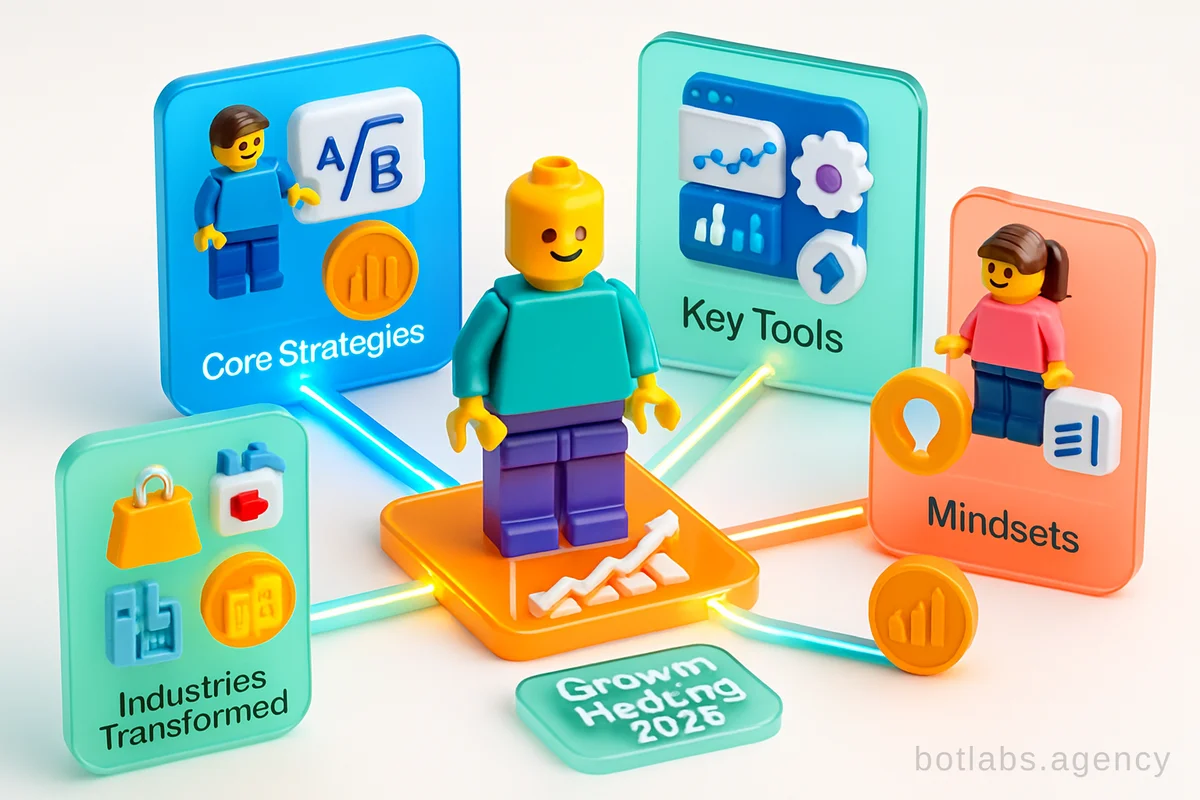
Growth hacking is often confused with growth marketing, but there's a crucial difference. Growth marketing is a holistic, long-term approach that optimizes every stage of the customer journey—from awareness to retention. Growth hacking, on the other hand, is a toolkit of tactical, high-leverage experiments designed to produce rapid, outsized wins.
Tip: Think of growth marketing as the engine, and growth hacking as the turbo boost—used strategically to break through plateaus or accelerate past bottlenecks.
The heart of growth hacking is relentless hypothesis testing. Rather than betting everything on a single campaign, teams run dozens of small experiments—A/B testing headlines, offers, onboarding flows, and more. The goal? Discover the "golden hack" that drives exponential growth, fast.
The Birth of Growth Hacking
Coined by Sean Ellis in 2010, "growth hacking" emerged from the startup world but has since become essential for businesses of all sizes. In today's digital ecosystem, it's not about having the biggest budget—it's about learning the fastest.
The Growth Hacking Process: Science, Not Chaos
Contrary to popular belief, growth hacking isn't random. It's a disciplined, scientific process built around cycles of experimentation. The most popular model is the HADI cycle:
- Hypothesis: Form a data-driven assumption (e.g., "If we add tooltips to onboarding, registration conversion will rise by 10%.")
- Action: Implement a minimal change (MVP) to test the hypothesis.
- Data: Collect and measure results over a set period.
- Insights: Analyze whether the hypothesis was correct; scale if yes, pivot if not.
Table: HADI Cycle Example | Stage | Example in Chatbot Project | |------------|-----------------------------------------------| | Hypothesis | Adding instant FAQ answers will cut support time| | Action | Deploy FAQ module to 20% of users | | Data | Measure avg. support response time | | Insights | If response time drops, roll out to all users |
Speed is the name of the game. Instead of waiting months to analyze results, growth hackers run multiple experiments weekly. Data—not opinions—determine what gets scaled.
Where to Focus: The AAARRR Funnel
The "Pirate Funnel"—AAARRR (Awareness, Acquisition, Activation, Retention, Revenue, Referral)—is the growth hacker's roadmap. Each stage presents opportunities for optimization, but some offer outsized impact.
- Awareness: How do prospects first learn about you?
- Acquisition: How do you attract them to your platform?
- Activation: When do they experience your product's value?
- Retention: Do they come back and engage again?
- Revenue: When do they pay?
- Referral: Do they invite others?
Callout: Tiny improvements in activation or retention can multiply long-term revenue, often more than pouring money into acquisition.
Essential Growth Hacking Tools and Tactics
Growth hacking isn't about magic tricks—it's about smart, systematic experimentation with the right tools. Here are proven approaches for 2026:
1. Product & UX Optimization
Your product is your best marketing tool. If it's clunky or confusing, no amount of advertising will fix it. Growth hackers obsess over user journeys: simplifying onboarding, reducing friction, and adding gamification to boost engagement.
- A/B Testing: Test everything—from CTA colors to onboarding flows.
- Microcopy Tweaks: Sometimes a small change in offer language drives more conversions than a full redesign.
- Example: In AstraDent's AI chatbot project, optimizing appointment reminders and instant answers led to a dramatic drop in missed appointments.
2. Offer and Price Experimentation
Pricing is a powerful lever. Test multiple subscription tiers, limited-time offers, or "decoy" plans to influence perception. Changing how value is presented (without altering the product) can unlock huge revenue gains.
- Example: Adding a "VIP" plan next to a standard offer often nudges users toward the mid-tier option, boosting average revenue per user.
3. Viral and Referral Loops
The best growth is exponential: when every new user brings in more users. Offer rewards for referrals, embed sharing incentives, and design features that encourage virality.
- Example: Dropbox famously gave users extra storage for inviting friends—a move that supercharged growth with minimal spend.
4. Automations and AI-Powered Experiments
Growth hacking thrives on automation. Chatbots, CRM integrations, and AI-driven content personalize experiences at scale and provide rapid feedback on what works.
- Example: KLEIBERIT's B2B support chatbot automated dealer support and product searches, reducing manual workload and boosting lead conversion.
Growth Hacking in Practice: BotLabs Agency Case Studies
BotLabs Agency leverages growth hacking principles across industries. Here are key examples:
Loyalty Chatbot for UA Made Retail Network
In this case study, a Telegram loyalty chatbot increased repeat purchases by 34%. Rapid A/B testing of onboarding flows, incentives, and referral programs identified the optimal combination for engagement and revenue growth.
AI Chatbot for Dental Clinics
For AstraDent, an AI chatbot automated appointment scheduling, answered FAQs, and sent reminders. This reduced no-show rates and improved customer retention—key points in the AAARRR funnel.
B2B Automation for Manufacturing
With KLEIBERIT, automating dealer interactions and product queries led to a 28% increase in lead-to-deal conversion. Fast experimentation with communication flows and support content was critical to success.
Growth Hacking vs. Classic Marketing: Why It Works
Traditional marketing often spends big on "top-of-funnel" awareness, but neglects what happens after the first click. Growth hacking takes a full-funnel view, optimizing every stage for ROI.
- Data-Driven: Every experiment is measured and iterated based on hard numbers.
- Resource-Efficient: Focuses on low-cost, high-impact tactics.
- Full Funnel: From acquisition to retention and referrals.
Table: Classic Marketing vs. Growth Hacking | Classic Marketing | Growth Hacking | |-----------------------------|-------------------------------------| | Long campaign cycles | Rapid, continuous experiments | | Big budget, broad targeting | Micro-targeting, lean spend | | Focus on acquisition | Full-funnel optimization | | Creative-driven | Data-driven, hypothesis-tested |
Practical Growth Hacking Tips for 2026
- Test Relentlessly: Run 5–10 experiments each week—on landing pages, emails, chatbot scripts, offers.
- Embrace Data: Let numbers guide decisions, not opinions.
- Map the Full Funnel: Don't just acquire users—activate, retain, and turn them into advocates.
- Automate Feedback Loops: Use chatbots and analytics to collect user insights in real time.
- Prioritize Quick Wins: Focus first on experiments with the highest potential ROI.
Tip: Use the AAARRR funnel as a checklist. Where are most users dropping off? That's your priority for hacking.
Growth Hacking Tools Checklist
- A/B Testing Platforms (e.g., Optimizely)
- Analytics Suites (e.g., Google Analytics, Mixpanel)
- Chatbot Builders (e.g., Telegram, WhatsApp, Viber integrations)
- Referral Program Tools
- CRM & Email Automation
- User Feedback Widgets
Growth Hacking and Integrated Marketing: A Symbiotic Relationship
Short-term hacks can deliver impressive spikes, but without a strong growth marketing strategy, they're unsustainable. Sustainable growth happens when structured experimentation is paired with brand consistency, solid unit economics, and a dedication to customer value.
Callout: The best teams blend rapid experimentation with strategic discipline—turning every failure into a learning opportunity and every win into a repeatable process.
Q1: How do I start with growth hacking if I'm a small business?
Start by mapping your customer journey. Run simple experiments—like changing a call-to-action or automating a follow-up message—and measure the results. Use free or low-cost tools before scaling.
Q2: What's the difference between growth hacking and regular marketing?
Growth hacking is experiment-driven, data-focused, and works across the entire funnel. Traditional marketing is often campaign-based and focused on awareness or acquisition only.
Q3: Can growth hacking work for B2B companies?
Absolutely. B2B success stories—like KLEIBERIT's dealer support chatbot—demonstrate that automation, personalization, and rapid iteration drive results in every sector.
---
For more insights on digital growth and automation, visit the BotLabs Blog or learn how chatbots can transform your business in 2026.

Need a chatbot for your business?
We automate your processes and boost sales.