Telegram Bots for Courier and Delivery Services: How to Transform Your Logistics in 2026
Introduction: The New Era of Delivery Automation
In 2026, logistics and courier services are more competitive than ever. Fast, reliable delivery is a major differentiator for e-commerce, food service, and B2B operations. With the rise of AI and messaging platforms, Telegram bots have become an essential tool for automating courier workflows, streamlining communication, and delivering outstanding customer experiences.
This article explores how Telegram bots can revolutionize delivery services, drawing on real-world examples—including loyalty chatbots for retail and automated booking bots for restaurants and gyms—to demonstrate best practices, pitfalls to avoid, and future trends.
What Is a Telegram Bot for Courier Services?
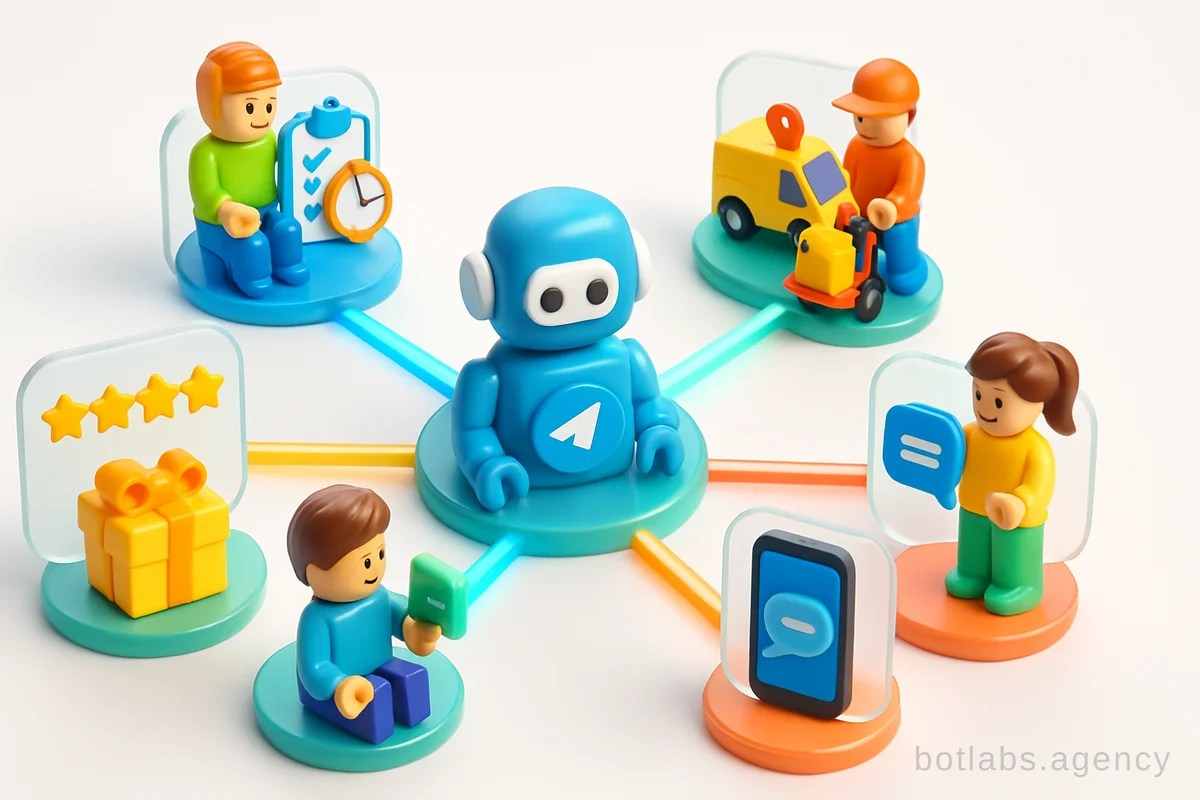
A Telegram bot for couriers is an automated assistant running inside the Telegram app. It interacts with couriers, dispatchers, and customers via chat or graphical interfaces, automating order management, route optimization, status updates, and even customer support tasks.
Modern Telegram bots often feature:
- Real-time order distribution: Assigning tasks to available couriers based on location and workload
- Integrated tracking: Updating order status for both staff and customers
- Route optimization: Suggesting the fastest delivery path via map integrations
- Document and report automation: Generating delivery logs and analytics
Tip: Your Telegram bot can also serve as a customer-facing channel, enabling instant order placement, real-time tracking, and feedback collection—all inside a familiar messenger.
Key Features of a Modern Delivery Telegram Bot
An effective courier bot should include a set of features tailored for logistics operations:
| Feature | Benefit |
|---|---|
| Order assignment | Faster dispatch, less idle time |
| Route optimization | Lower fuel costs, faster deliveries |
| Real-time tracking | Transparency for customers and managers |
| Status notifications | Fewer support calls, improved communication |
| Integrated support | Quick operator access for issue resolution |
| Analytics & reporting | Data-driven improvements for operations |
| Multi-language support | Serving diverse customer bases |
For example, the AstraDent chatbot automates booking and reminders for clinics, while the Jewelry Factory chatbot streamlines catalog browsing and loyalty management—demonstrating how similar features can be adapted to courier scenarios.
How Telegram Bots Simplify Courier Workflows
Telegram bots address the biggest pain points in courier operations:
- Order Intake and Distribution: Bots automatically receive orders from your website, app, or even phone calls, then allocate them to available couriers based on pre-set logic (location, availability, workload).
- Route Planning: Integrated with mapping APIs, bots suggest optimal paths, reducing delivery times and costs.
- Status Updates: Couriers update order progress via quick buttons—customers and managers see real-time statuses, reducing WISMO (“Where is my order?”) calls.
- Communication: Chatbots provide a direct line between couriers, dispatch, and customers. Urgent questions, address clarifications, or schedule changes can be handled instantly.
- Reporting: Automated logs track completed deliveries, time taken, and other KPIs—enabling better performance analysis and incentive planning.
Tip: Design your bot for mobile-first use. Couriers are often on the move—intuitive interfaces and one-tap actions reduce errors and speed up processes.
Interface Options: Text vs. Mini App
Telegram bots now support both classic text-based interactions and richer graphical interfaces (Mini Apps). Which is right for your business?
- Text-based bots are fast to develop and easy to use—even for non-tech couriers. They work well for simple tasks and structured workflows.
- Mini Apps offer a full-fledged UI with buttons, menus, maps, and even embedded forms. Ideal for complex operations, interactive order management, or when you want to provide a seamless, app-like experience inside Telegram.
Example Table: Interface Comparison
| Interface Type | Pros | Cons |
|---|---|---|
| Text-only | Quick setup, universal access | Limited UI, less visual |
| Mini App | Rich UX, interactive, supports media/maps | Longer dev time, more testing |
Tip: For large courier fleets or B2B logistics, consider a hybrid approach—start with text, then evolve to a Mini App as your needs grow.
Essential Integrations for Courier Bots
The true power of a Telegram bot lies in its integrations:
- Order management systems (OMS): Sync new orders, status, and courier assignments
- CRM: Track customer data, preferences, and delivery history
- Maps & geo APIs: Real-time navigation, address validation, and branch locator
- Payment gateways: Enable cashless, in-app payments for deliveries
For instance, the NOVUS Viber bot integrates with loyalty systems and POS, while the UA Made loyalty chatbot connects to customer profiles—similar integration strategies can boost courier efficiency.
Security and Data Privacy: Non-Negotiable
Courier bots handle sensitive data: names, addresses, phone numbers, and order details. Best practices include:
- Secure authentication (e.g., email-based login, one-time codes)
- Role-based access for couriers, managers, and admins
- End-to-end encryption for sensitive communications
- GDPR and local compliance for customer data
Tip: Regularly audit your bot’s access logs and user permissions to prevent data leaks or unauthorized usage.
Real-World Example: Delivery Service Bot in Action
Consider the Delivery Auto Telegram bot, which offers:
- Operator support (hotline, customer service, address management)
- Branch locator by geolocation or city name
- Courier request and order tracking in a few taps
- Instant rate info and digital document management
- Franchise application support for network growth
Such bots transform the courier experience—making order handling, communication, and customer satisfaction far more efficient.
Common Mistakes and How to Avoid Them
- Overcomplicated UI: Busy couriers need simplicity. Avoid too many steps or hidden menus.
- Lack of integration: If your bot doesn’t sync with your OMS or CRM, manual errors and double work will persist.
- Ignoring feedback: Regularly survey users (couriers and customers) to spot pain points and improve the bot iteratively.
- Neglecting security: Weak authentication or excessive data exposure can lead to breaches and loss of trust.
Future Trends: What’s Next for Courier Bots?
- AI-powered routing: Bots that dynamically adjust routes based on traffic and weather
- Voice interface: Hands-free bot commands for couriers on the move
- Predictive analytics: Automated workload planning for peak times
- Hyper-personalized customer updates: Automated ETA predictions and proactive notifications
Already, bots like the restaurant chatbot are demonstrating the power of AI and automation in high-volume, client-facing environments.
Practical Tips for Implementing a Courier Telegram Bot
- Map your workflow: List all courier touchpoints (order intake, dispatch, delivery, reporting, support).
- Start simple: Launch with core features (order assignment, status updates) and expand iteratively.
- Prioritize integrations: Ensure your bot connects with your existing systems.
- Involve users early: Let couriers and dispatchers test prototypes for real-world usability.
- Plan for support: Set up escalation channels for issues the bot can’t handle.
Tip: Partner with an experienced agency. BotLabs Agency offers end-to-end bot development, from analysis to deployment and ongoing support.
Q1: How long does it take to develop a Telegram bot for courier services?
A: With a professional team, a custom bot can be built and launched in 2-4 weeks. Complexity and integrations may extend timelines.
Q2: Can Telegram bots be integrated with my existing logistics software?
A: Yes, modern bots are designed to sync with OMS, CRM, and mapping systems—ensuring seamless workflows.
Q3: What is the average ROI of implementing a courier Telegram bot?
A: Businesses typically see a 25%-40% reduction in manual workload, faster delivery times, and higher customer satisfaction, translating to measurable ROI.

Need a chatbot for your business?
We automate your processes and boost sales.